Simam Repair Hub
A vehicle repair management platform for insurers and their bodyshop networks. Built end to end on .NET 10 and React by an engineer directing Claude Code agents: planned, coded, tested and deployed to AWS.
RJ-2026-0417 · J3F9B4EOverdue 3 daysRJ-2026-0452 · P2K2C2PEstimate approvedOne live record for every repair
Insurers, repair coordinators and bodyshops work from the same job. Each one moves through a strict lifecycle: the system refuses out-of-order steps and flags anything falling behind its working-day SLA.
Insurers
Notify claims, choose a bodyshop, approve or reject estimates and see every job's cost and SLA at a glance.
Repair coordinators
A Kanban job board with fuzzy search and an overdue filter that counts UK working days and skips bank holidays.
Bodyshops
Submit estimates, book appointments, record inspections and invoice, but only on the jobs assigned to them.
Built to a spec, end to end
Designed from written requirements and recorded decisions; every slice shipped tested and reviewed.
An engineer directing AI agents
Repair Hub was delivered with an agentic workflow in Claude Code. The engineer owns the brief, the guardrails and every review; agents do the planning, building, testing and shipping, each step checked before the next.
Brief and guardrails
Requirements written as Given / When / Then. Rules set up front: security, naming, cost limits, no deploy without approval.
Plan and decide
Agents research current versions and record six architecture decisions, each with options and trade-offs.
Build in slices
Five vertical slices, each ending green. Independent work runs in parallel agent sessions with agreed file ownership.
Verify and ship
Tests run, generated SQL inspected, images built and examined, releases smoke-tested through CI and AWS.
Agents catch their own mistakes when the workflow makes them prove each step: a deploy test that could never fail and a mis-scoped cloud permission were both found and fixed before release.
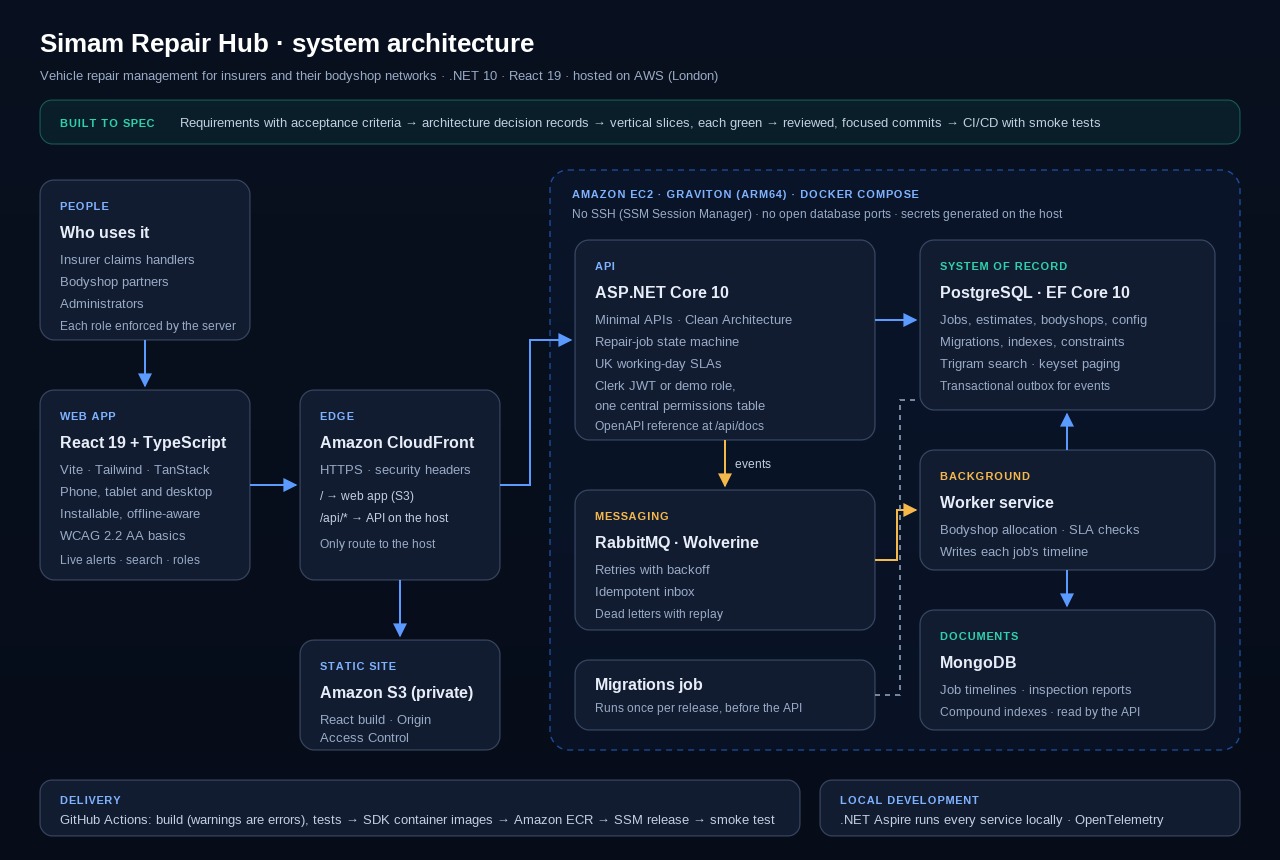
A modern .NET and React stack
The stack an enterprise .NET team runs today, on current long-term-support versions.
Platform
Domain state machine for the job lifecycle; plain, testable use-case handlers.
Orchestration
One command starts the API, worker, databases and broker locally with tracing and a live dashboard.
Data
Relational jobs and estimates in PostgreSQL; timelines and inspection reports as MongoDB documents.
Messaging
Events are saved with the data, delivered once to the worker, retried with back-off, and parked for replay if they fail.
Front end
Responsive, accessible screens for each role, driven directly by the API.
Cloud and delivery
CloudFront, S3, Graviton EC2 and ECR; CI on every push; scripted one-command releases and rollback.
Production habits, not a prototype
See it running
Open the dashboard, search the job board for a registration, and open a claim to follow its timeline. Switch role in the header to assign a bodyshop or approve an estimate. No sign-in needed.
Open the live demoPublic API reference · Source available on request. All vehicles, customers, insurers and bodyshops are fictional.