01 Challenge
The product problem
Airside procedures are difficult and costly to rehearse safely in live operational environments. Training teams need realistic repetition without disrupting airport activity or exposing learners to unnecessary risk.
Client/Sector: Simam Digital / aviation training POC
A Meta Quest-focused airport operations simulator for repeatable airside training scenarios.
Project Snapshot
01 Challenge
Airside procedures are difficult and costly to rehearse safely in live operational environments. Training teams need realistic repetition without disrupting airport activity or exposing learners to unnecessary risk.
02 Approach
I shaped an immersive training product around practical ground-handling, aircraft marshalling and passenger-safety scenarios. Voice guidance, grading, replay and weather variants turn the experience into a structured learning tool rather than a passive VR demonstration.
03 Execution
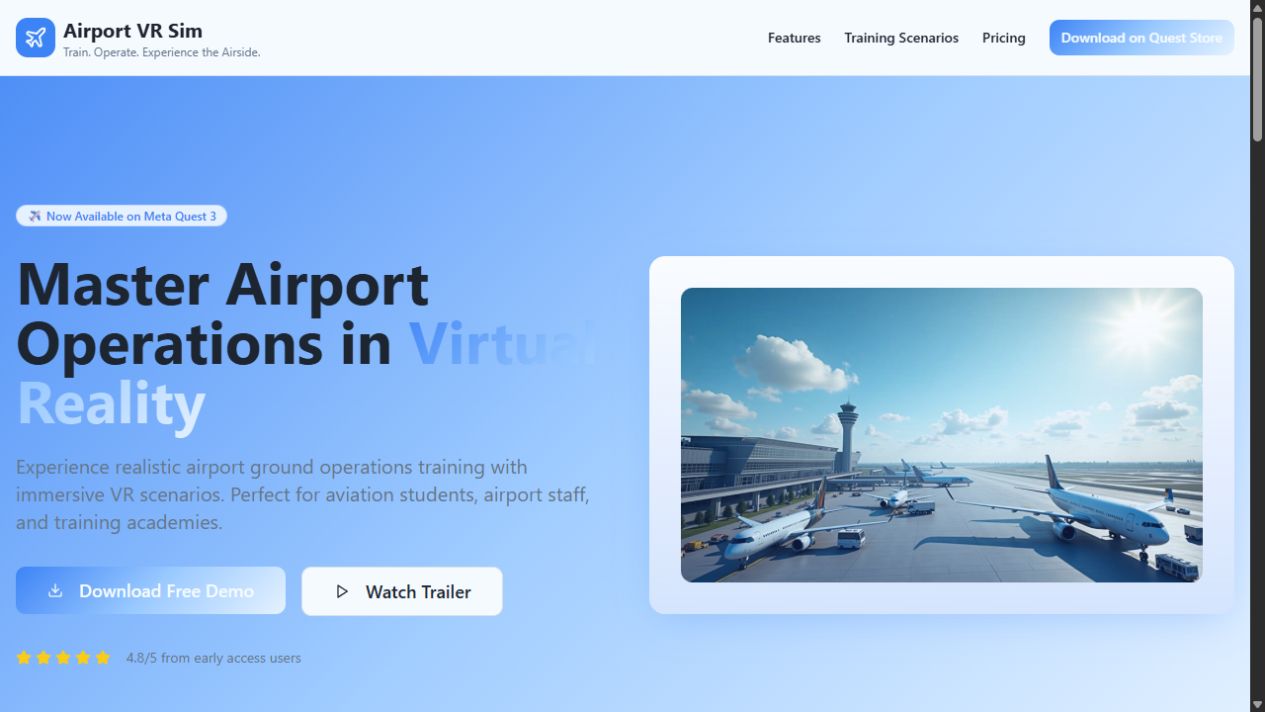
The prototype combines interaction design for Quest controllers, believable airport environments and scenario-based progression. The supporting product site explains the modules, audience and commercial model clearly enough for education and enterprise conversations.
04 Outcome
The result is an NDA-safe Simam Digital POC showing how procedural VR can improve practice frequency, assessment consistency and stakeholder confidence before a full deployment.
Technical delivery
The simulator was designed as a training system rather than an airport-themed VR scene. Scenario progression, instruction, assessment and reset behaviour had to make repeated practice measurable and consistent on standalone headsets.
Each exercise needed a defined start condition, ordered or conditional tasks, safety-critical errors, completion criteria and a reliable reset. Modelling those states separately from scene objects made scenarios easier to test and allowed guidance, scoring and replay to describe the same learner progress.
Controller input, reach, object affordances and feedback were shaped around the physical sequence being taught. Voice and visual guidance could support a first attempt, then step back for assessment. Weather or operating variants changed context without changing the core evaluation model.
A believable airport environment had to fit Quest frame, memory and thermal budgets. Scene composition, texture use, lighting and active interactions therefore formed part of training design. Stable frame rate and predictable input are learning requirements: discomfort or missed actions would invalidate assessment as well as harm UX.
Project summary
No. It is presented as a self-hosted Simam Digital product or NDA-safe proof of concept without identifying confidential clients.